In case you've not heard, the New Year comes in tonight. December 31 marks the end of the first calendar year of this blog, although the first post didn't show up until May 4. The average daily visitors has grown by about 400% since that first month. That's not what's the most interesting point, however. One of the things that I find interesting is the pages that have been viewed the most...
Here are the top 5 pages for this blog for all of 2011:
1. My Paper from the Northern Great Plains History Conference
2. Jan Hus--Pics from Bethlehem Chapel in Prague
3. Perry, Romney, and Mormonism
4. New England Execution Sermons
5. Olomouc, Czech Republic--Pics Included
From this quick perusal of the most popular posts, it appears that people like pictures of cool things from a foreign country. That's no big surprise. A couple of other topics that surprised me as to their popularity (as shown from search results) were Mormons and execution sermons. The Mormons may be getting a bit more press this year because two of their number are running for president. New England execution sermons, or some variation of this topic received quite a bit in the way of search traffic, which was very surprising. Perhaps, people enjoy reading about morbid stuff. I enjoyed the book Between Heaven and Earth, the subject of my post on the subject of Puritan execution sermons.
What topics did you find most interesting? What topics would you like to see covered in the future? I'm interested to know going forward.
Oh, yeah, and have a great 2012--even if the Mayans were right.
Showing posts with label Czech Republic. Show all posts
Showing posts with label Czech Republic. Show all posts
31 December 2011


09 November 2011
The Church in the Wildwood
This summer, I had the opportunity (quite by accident) to visit the Little Brown Church in the Vale. This church was made famous by the song on the "Church in the Wildwood." I happened to drive by it on my way back from a trip home with the family to West Virginia. We decided to take the kids to the St. Louis Gateway Arch and driving through rural Iowa was the shortest route from St. Louis to North Dakota.
The Little Brown Church in the Vale showed up on the map as a landmark of interest. Being the church nut that I am, I had to stop and see the church since it was only a couple of miles off of the highway. This Congregational church sits just outside of Nashua, Iowa, and dates to the 1860s. It is easily accessible from US Highway 218. While not an imposing structure like some of the churches in the Czech Republic that I've posted on this site, it was nonetheless pretty cool to see a historic country church. The church is still in use, and hosts many weddings on an annualized basis. The church also holds baptism on Sunday afternoons. The church is memorialized by the song, and is a link to the pioneer days. Often, one of the earliest structures built in new towns was a church (or churches). Many of these churches no longer stand, but they were an important part of pioneer life. It's impossible to tell the story of American history (or the history of just about any nation) without mentioning the history of religion. In America, that religion is Christianity. The early settlers had beliefs that influenced the way that they lived. Below are photos of the the Little Brown Church in the Vale:


The Little Brown Church in the Vale showed up on the map as a landmark of interest. Being the church nut that I am, I had to stop and see the church since it was only a couple of miles off of the highway. This Congregational church sits just outside of Nashua, Iowa, and dates to the 1860s. It is easily accessible from US Highway 218. While not an imposing structure like some of the churches in the Czech Republic that I've posted on this site, it was nonetheless pretty cool to see a historic country church. The church is still in use, and hosts many weddings on an annualized basis. The church also holds baptism on Sunday afternoons. The church is memorialized by the song, and is a link to the pioneer days. Often, one of the earliest structures built in new towns was a church (or churches). Many of these churches no longer stand, but they were an important part of pioneer life. It's impossible to tell the story of American history (or the history of just about any nation) without mentioning the history of religion. In America, that religion is Christianity. The early settlers had beliefs that influenced the way that they lived. Below are photos of the the Little Brown Church in the Vale:


16 August 2011
Prague, Czech Republic--Photos Included
Here is the last post that will include pics of my recent trip to the Czech Republic. Prague has been called the Town of a Thousand Spires because of the many churches that remain from the medieval and early modern periods. Perhaps the most impressive church that I saw in Prague was the St. Vitus Cathedral, which sits inside the walls of the Prague Castle.
 While I did not include any pictures of the sides of this impressive structure, one thing that I found interesting was the gargoyles and other strange looking creatures that adorned the outside of the church and that served as a sort of gutter to remove rain runoff (actually into the street several stories below). The inside of the structure has a very high vaulted ceiling, which is to be expected from viewing the pic above.

I have already posted pictures of the Bethlehem Chapel and the Jan Hus Monument, so I will not include them again. The links above will access these photos.
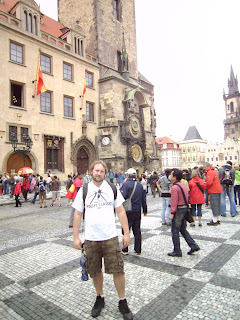
 The Town Square of Prague is also a favorite site for visitors to check out. One of the posts noted above has pictures of one of the monuments in the square. However, the Jan Hus monument is not the only famous structure in the square. The Prague Town Hall sits at the edge of the square and houses an astronomical clock. Hundreds (if not thousands) of tourists mass around the clock near the turn of each hour to observe the clock going off. The clock has doors that open to reveal medieval-looking figures on a turntable, as well as a skeleton on the outside that rings a bell. After all of these festivities, a trumpet belts out a few measures, and the clock is silent for another hour. Here is a pic of me standing in front of the Town Hall.
 Another impressive church in Prague is the Church of Our Lady before Tyn, depicted here:
 While these are just a few of the pics that I took while visiting Prague, they do give a good overview of some of the more impressive structures and most famous sites that tourists like to frequent.


I have already posted pictures of the Bethlehem Chapel and the Jan Hus Monument, so I will not include them again. The links above will access these photos.
One of the biggest tourist attractions in Prague is the Charles Bridge, which spans the Vltava River and allows access to the Castle from the Old Town. Various street vendors stake out positions on the Charles Bridge to sell their wares to tourists. Here is a view of the Charles Bridge (note the statues that adorn the bridge):
The Prague Castle is an important landmark that stands on a hill above the Vltava River and most of the city. Here is a pic of the Castle. Note the St. Vitus Cathedral in the center of the Castle:


10 August 2011
Olomouc, Czech Republic--Pics Included
During my recent trip to the Czech Republic, my group spent a few days in the town of Olomouc, which has a population of around 100,000. Olomouc is located in the Moravian province of the Czech Republic, and has many historical sites and churches. Seeing that church history (broadly interpreted) is one of my major interests, I enjoyed seeing many of these sites. One of the highlights of the stay in Olomouc was the opportunity to worship with the Olomouc Baptist Church and meet some of the members of the church. Other highlights include some of the sites depicted below. Info on some of the sites can be found at this website.
In my opinion, the most impressive structure (from a visual and architectural standpoint, anyway) in the town is St. Wenceslas Cathedral. The origins of this building date to the twelfth century according to the website listed above, although the current Gothic look resulted from later renovations.

One of the more interesting aspects of a tour of this particular church is the opportunity to descend two floors to a mausoleum that houses the remains of some of the more famous bishops that worked in this parish.
The town square in Olomouc has several interesting monuments. One of these monuments is the Holy Trinity Column. From what some friends told me, it is possible to "tour" the inside of the column, although I did not do so.
 The square in Olomouc is divided into the Upper Square and Lower Square. The dividing line between the squares is the Town Hall, which houses a tourism center and an astronomical clock. The town hall is depicted below:
 Another of the churches in Olomouc is St. Maurice. I did not go into the main auditorium of this church because a service was in session. However, there is tower on one side of the church that is open to the public. This tower houses the church's bells and allows access to the roof of the structure. The view from this roof offers a great panorama of Olomouc. The view below includes the town square with a good view of the Town Hall.
 Here is a view from inside the guts of the bell tower in St. Maurice. I am glad that the bells did not ring while I was walking up the stairs!
 The final pics that I will post have little to do with the historic culture of Olomouc, but rather depict our lodging during our stay in Olomouc. The first is a street-level view of the Baptist College in Olomouc, while the second is a view of the street from the third floor of this school. Note how the buildings follow the contour of the street. I've found this common in both the Czech Republic and London, England. Note the cobble-stone streets. Most streets exhibit this feature, although the highways are made of asphalt, much like in the states.

 The stay in Olomouc was quite pleasant, and, although there were some signs of American corporate influence, such as a McDonald's in the town square (which was somewhat obscured by construction), the town has quite a bit of Old World charm and much in the way of history.
In my opinion, the most impressive structure (from a visual and architectural standpoint, anyway) in the town is St. Wenceslas Cathedral. The origins of this building date to the twelfth century according to the website listed above, although the current Gothic look resulted from later renovations.

One of the more interesting aspects of a tour of this particular church is the opportunity to descend two floors to a mausoleum that houses the remains of some of the more famous bishops that worked in this parish.
The town square in Olomouc has several interesting monuments. One of these monuments is the Holy Trinity Column. From what some friends told me, it is possible to "tour" the inside of the column, although I did not do so.


07 August 2011
Prague Pics--Jan Hus Monument
Yesterday, I posted some pics and commentary regarding the Bethlehem Chapel in Prague, Czech Republic. The Bethlehem Chapel is famous as the home base of the religious reformer Jan Hus, who was sentenced to death as a heretic by the Council of Constance in 1415. Today, Hus is widely considered a national hero in the Czech Republic, and there are monuments erected to his memory. The Bethlehem Chapel itself is a monument to Hus, and is open to the public for a cost of 50 Czech Crowns (about $3 US).
Another major monument to Hus is located in the Prague town square. Each town that I visited in the Czech Republic had a town square that included a town hall (some pics of these will be forthcoming) and various shops, churches, and restaurants. Here are a couple of pics of the Jan Hus memorial in the Prague town square:

The monument was officially unveiled on the 500th anniversary of Hus's execution in 1415. As a nation that has often been under foreign domination, the Czech Republic views Hus as a national hero for standing up to one source of foreign domination. Here is a link with information regarding the monument itself.

Another major monument to Hus is located in the Prague town square. Each town that I visited in the Czech Republic had a town square that included a town hall (some pics of these will be forthcoming) and various shops, churches, and restaurants. Here are a couple of pics of the Jan Hus memorial in the Prague town square:

The monument was officially unveiled on the 500th anniversary of Hus's execution in 1415. As a nation that has often been under foreign domination, the Czech Republic views Hus as a national hero for standing up to one source of foreign domination. Here is a link with information regarding the monument itself.

06 August 2011
Jan Hus--Pictures of Bethlehem Chapel in Prague
In 1415 Bohemian religious reformer Jan Hus met his Maker after running afoul of Pope John XXIII over the sale of indulgences. Hus also agreed with many of John Wycliffe's teachings. Much of Hus's preaching took place at the Bethlehem Chapel in Prague, where he was also a rector at the university. In the fifteenth century, the chapel had no seating and people stood to hear Hus preach, up to 3,000 at a time. A Catholic view of Hus is available at the online Catholic Encyclopedia New Advent. As an evangelical, I don't agree with the execution, nor the heresy charges, but this website gives the official reasoning for Hus's execution.
During my visit to Prague, I was able to take a short tour of Bethlehem Chapel.

Here is a photo of the exterior of the Bethlehem Chapel in Prague.
The use of the chapel is now generally restricted to the university and tours, except for a somewhat ecumenical service on the anniversary of Hus's burning at the stake. The chapel now has chairs, but one of the most interesting aspects of the main auditorium is a well:

Here is an interior view of the Bethlehem Chapel. Note the well in the foreground. Artwork adorns each wall. A door opens to the box above the platform. The rooms on the other side of the door housed Hus during his rectorship and now house museum exhibits regarding the history of Hus and Prague.

Here is one of the more striking images on the walls of the Bethlehem Chapel. This image depicts the actual execution of Jan Hus.
While Hus did not directly affect American church history because of his European background, he is widely acknowledged as a precursor of the Protestant Reformation that broke out nearly 100 years after his execution. There is also a tie between England and Hus through his espousing the teachings of Wycliffe. Even though Hus was not an American, it was pretty cool to stand in a room as an evangelical and think that exactly 600 years ago, one of the forerunners of the Protestant Reformation preached to huge crowds in this very hall at the risk of his very life. Few places can hold such a significance.
During my visit to Prague, I was able to take a short tour of Bethlehem Chapel.

Here is a photo of the exterior of the Bethlehem Chapel in Prague.
The use of the chapel is now generally restricted to the university and tours, except for a somewhat ecumenical service on the anniversary of Hus's burning at the stake. The chapel now has chairs, but one of the most interesting aspects of the main auditorium is a well:

Here is an interior view of the Bethlehem Chapel. Note the well in the foreground. Artwork adorns each wall. A door opens to the box above the platform. The rooms on the other side of the door housed Hus during his rectorship and now house museum exhibits regarding the history of Hus and Prague.

Here is one of the more striking images on the walls of the Bethlehem Chapel. This image depicts the actual execution of Jan Hus.
While Hus did not directly affect American church history because of his European background, he is widely acknowledged as a precursor of the Protestant Reformation that broke out nearly 100 years after his execution. There is also a tie between England and Hus through his espousing the teachings of Wycliffe. Even though Hus was not an American, it was pretty cool to stand in a room as an evangelical and think that exactly 600 years ago, one of the forerunners of the Protestant Reformation preached to huge crowds in this very hall at the risk of his very life. Few places can hold such a significance.
03 August 2011
Vitkov, Czech Republic (Photos Included)
Over the past two weeks, as mentioned in my previous post, I was able to experience the Czech Republic. Other than a couple of layovers, this was my first opportunity to visit Europe for any length of time. My main purpose for going to the Czech Republic was to teach in an English camp that a Czech Baptist Church sponsors every year. In spite of this being a sort of "working vacation" that tended to be quite busy, my group took in several sites throughout the country.
The English camp itself took place near the village of Vitkov in a smaller village called Vitkov-Podhradi. The camp took place in a complex that serves as a boarding school during the academic year. This being summer (although the cool and wet weather indicated otherwise), school was not in session. Here is a view of the small village from the main academic building of the school.
 The small village of Vitkov-Podhradi had very little business, other than a small hotel and a pub, so the location was fairly remote.
Nearly every village or town or village in the Czech Republic has a fairly large church that goes back to a time before the Communist era in which the majority of Czechs identified with the Roman Catholic Church. Here is an example from the small town of Vitkov proper.

Most towns also have a town square that serves as a sort of market, Vitkov is no different:

In the coming days, I will post additional images and comments related to my trip in the Czech Republic. While these are related to American church history, they nonetheless have some relation to church history because of the many churches and chapels.
The English camp itself took place near the village of Vitkov in a smaller village called Vitkov-Podhradi. The camp took place in a complex that serves as a boarding school during the academic year. This being summer (although the cool and wet weather indicated otherwise), school was not in session. Here is a view of the small village from the main academic building of the school.
 The small village of Vitkov-Podhradi had very little business, other than a small hotel and a pub, so the location was fairly remote.
Nearly every village or town or village in the Czech Republic has a fairly large church that goes back to a time before the Communist era in which the majority of Czechs identified with the Roman Catholic Church. Here is an example from the small town of Vitkov proper.

Most towns also have a town square that serves as a sort of market, Vitkov is no different:

In the coming days, I will post additional images and comments related to my trip in the Czech Republic. While these are related to American church history, they nonetheless have some relation to church history because of the many churches and chapels.
31 July 2011
In Prague
The past couple of weeks have been on the sparse side when it comes to posting. I'm now in a Prague hotel, getting ready to leave in a couple of days after a two-week stay in the Czech Republic. The group I am with is planning to tour Prague tomorrow. We also spent some time in Olomouc, which is a moderately large city in the Moravian section of the Czech Republic. We spent most of our time teaching in an English camp that was sponsored by a Czech Baptist Church and held near the small village of Vitkov. I have met many wonderful people during my stay here.
I will post photos of some of the historical sites and churches that I have visited after my return to the states, even though they are not directly related to American church history.
I will post photos of some of the historical sites and churches that I have visited after my return to the states, even though they are not directly related to American church history.
Subscribe to:
Posts (Atom)